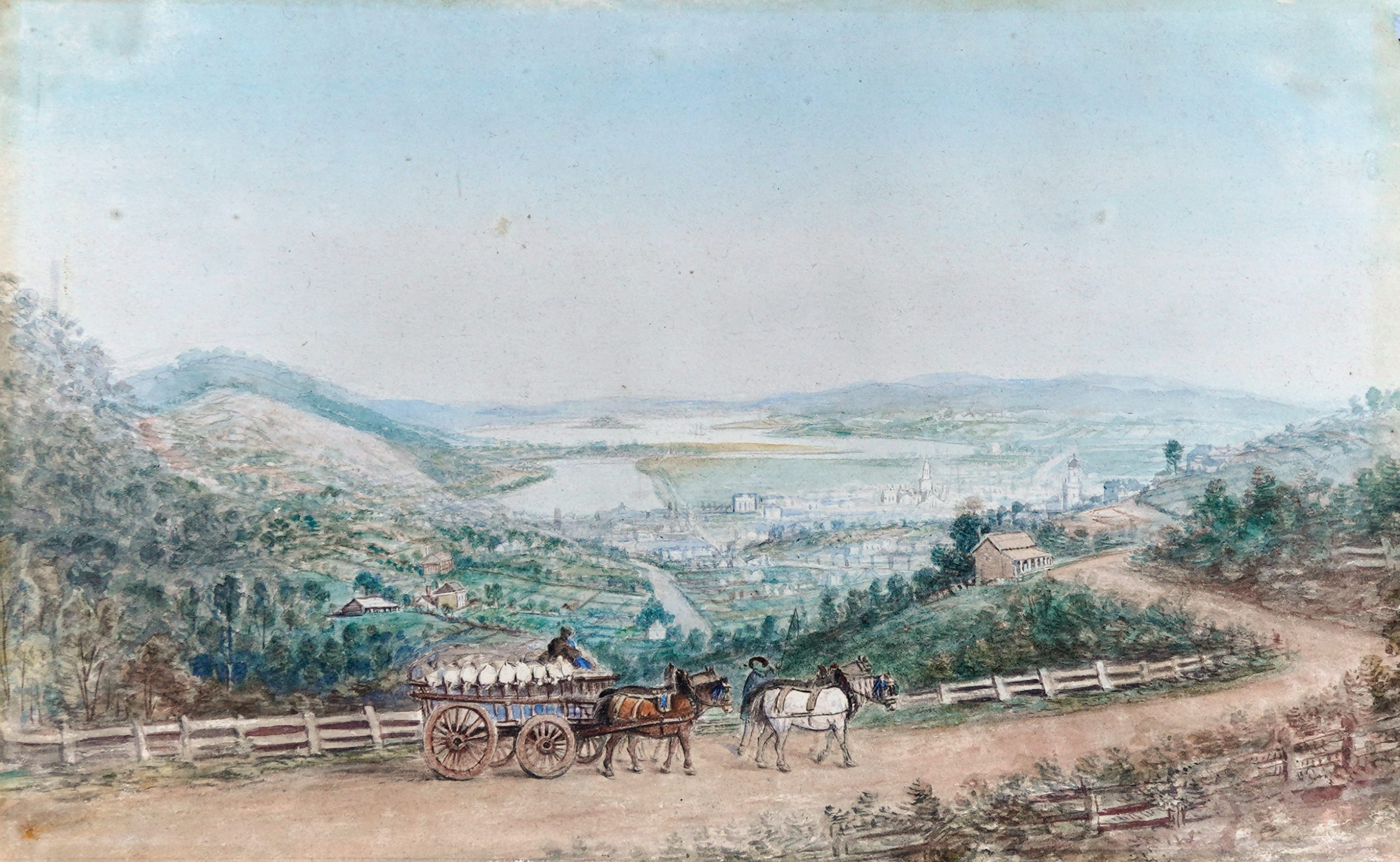
A Frederick Strange watercolour with Clifford Craig Provenance

Fresh to the market: an important Colonial work of art by a notable Convict Artist. This small but detailed watercolour was recently discovered in a Geelong residence — coming directly from the collection of Clifford Craig, the great early collector of Australiana.
Frederick Strange — Convict Artist
Frederick Strange was born in 1807 and claimed to be a “portrait and house painter” from Nottingham. In 1837 he was arrested in Colchester for robbery — the theft of silver spoons and a gold pocket watch, which he was wearing when caught. He was transported and arrived in Hobart in early 1838.
Initially unassigned, he was eventually assigned to a Mr Woodcock Graves — a carriage painter and artist who had arrived in Hobart in 1833. Strange was a natural fit, given his claimed background. However, things were not good at the Graves establishment. In 1840 the Colonial Times reported that Strange had “been the principal support of the family” yet his master “was in the habit of beating him, and has latterly become so outrageous that the man is in fear of his life.”

The Robbery Irony

The irony is remarkable: Strange had been convicted for theft in England — the key item being a pocket watch. Transported to Tasmania, he then witnessed the opportunistic theft of four pocket watches by soldiers, gave chase, and when the shop assistant caught up with them, Strange was standing there holding them — having picked them up after the thieves ran straight towards him and threw them down just three yards away. The soldiers were transported for life.
Strange received his ticket of leave in 1845 and a conditional pardon in 1849. Throughout the 1850s he actively painted and exhibited, while always looking for commissions. His 1855 advertisement offered “Lessons given in Landscape Drawing, Portraits painted in oil, or taken by Daguerreotype.” Within a few years he had lost interest in painting and is listed as a “Grocer.” He died in 1873.
— Paul Rosenberg, October 2024